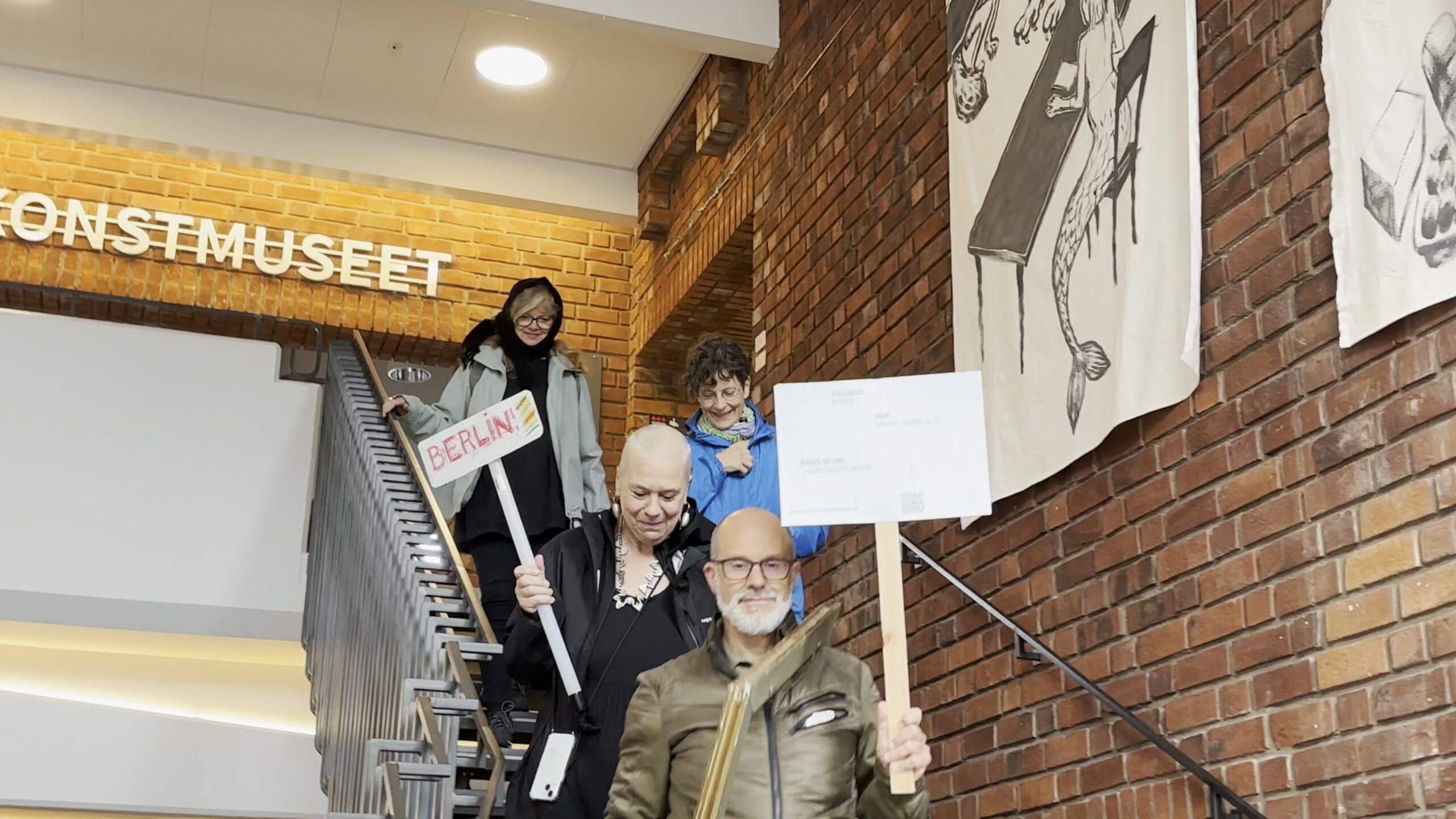
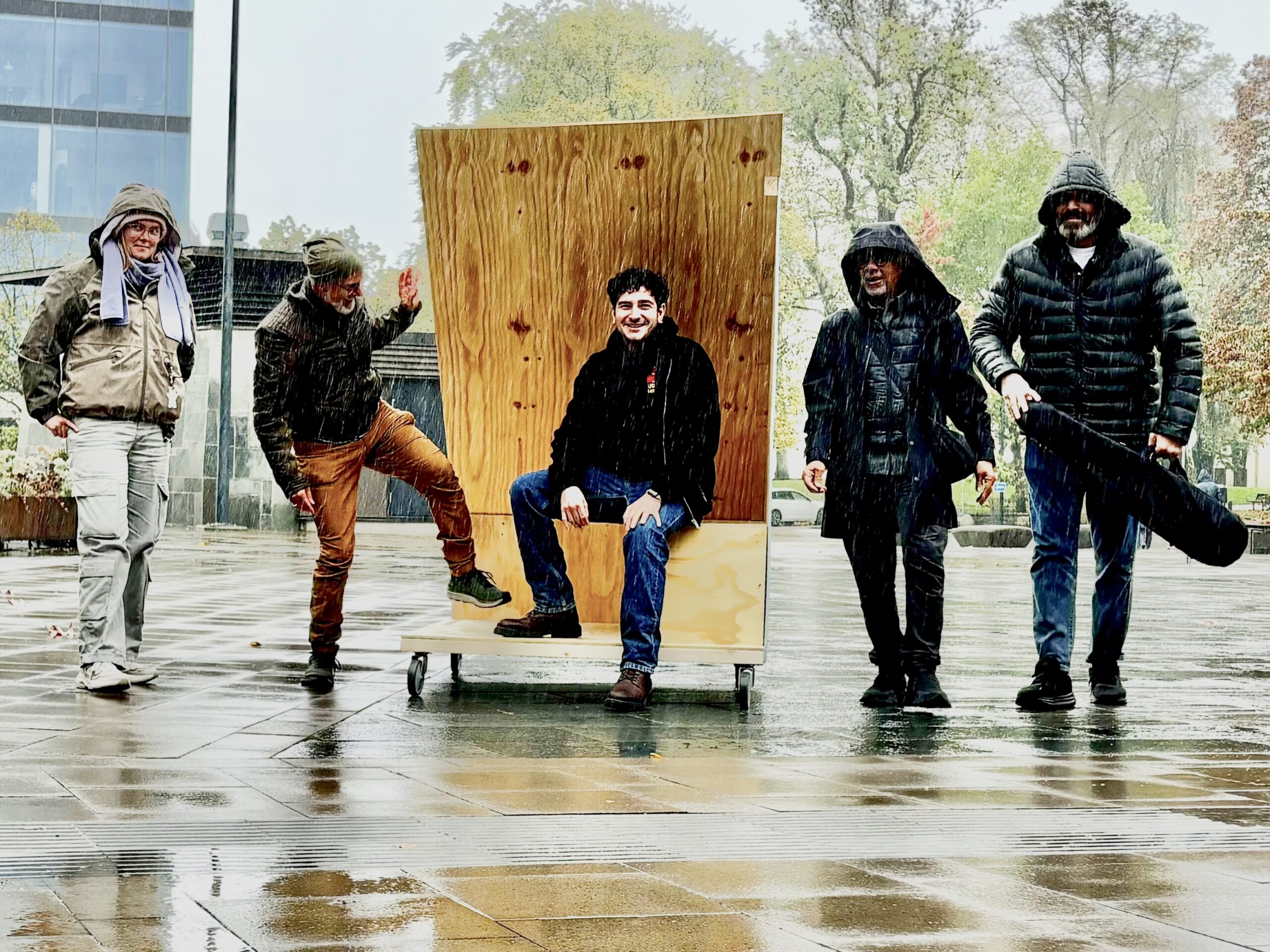
I had imagined that we would walk through the small town of Skövde in central Sweden, accompanied by interested participants who had learnt about the artistic activities carried out by myself and other artists from EULENGASSE during our two-month artist residency here. I had already given a philosophical talk on Wednesday about ‘shelter’, about protection and security. This was to be followed by a walk through Skövde, during which we would explore places that offer us shelter, spaces we inhabit, boundaries we cross, and detect thresholds between inside and outside.
But the rain had other plans. So we stayed at the Kulturhus. And perhaps that was already the first lesson of the day: shelter is never quite what we expect…
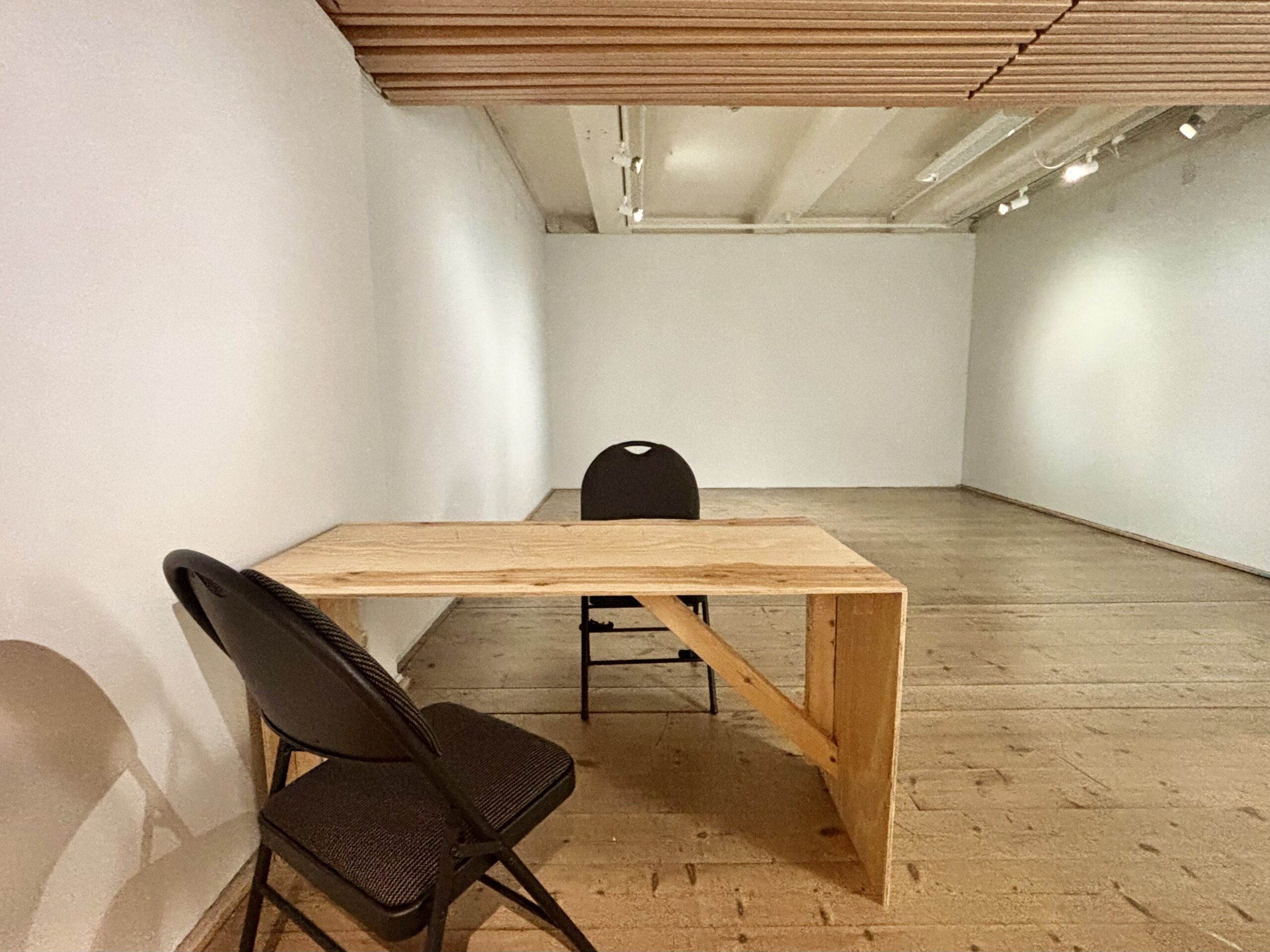
With the help of David from the museum team, I had built a mobile shelter structure from reused materials. Made from thin standard veneer boards, a few square timbers, wheels – and a couple of practical considerations. The dimensions weren’t chosen at random: the structure had to fit through the elevator door, be able to turn within the available space, and be manoeuvred through the city. Architecture begins with an idea, but just as much with the unyielding reality of dimensions, doors, floor thresholds and turning circles. The wood was left untreated. One side of two of the panels was blue and still bore traces of its former life. A label from the previous user, reading ‘Future has desires…’, was also still stuck to the base panel. I liked that. The structure did not pretend to be something new. It had already been in another place, had served a different purpose, and was now meant to become something new.
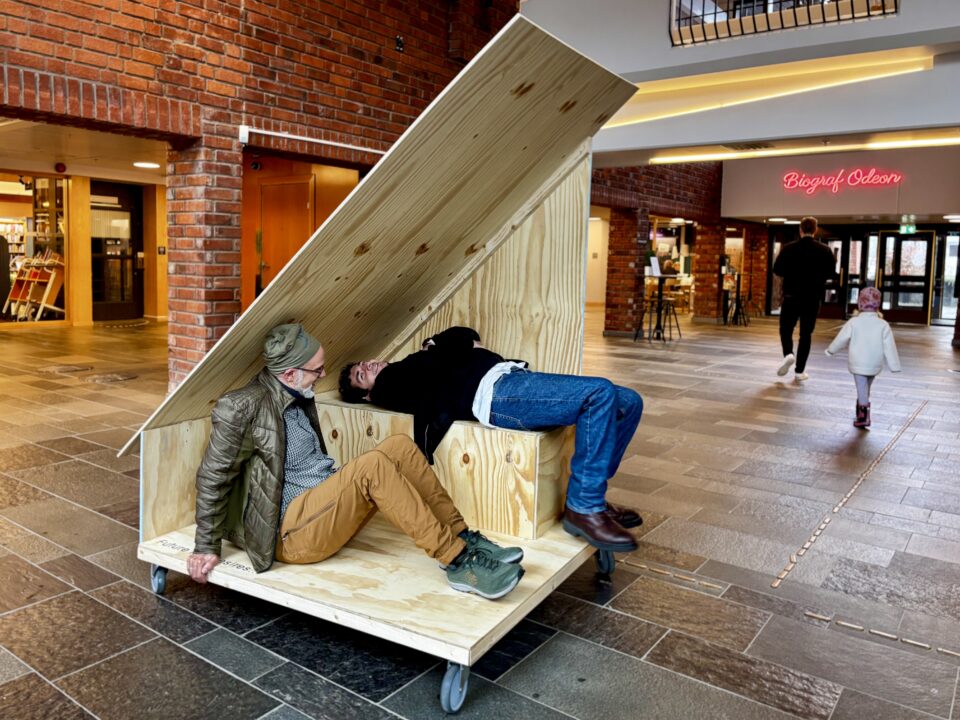
As an architect, I usually think about shelter in terms of structure, materials, thermal performance, protection from wind and rain, and the relationship between a structure and its surroundings. Yet I wanted to explore something that cannot simply be drawn in a floor plan or section. What makes a place safe? When does a structure become a place of refuge? And from what, exactly, are we seeking shelter?
The mobile structure was my attempt to give these questions a physical presence. Not a finished building, but an invitation. Something between architecture, sculpture and a tool for thought.
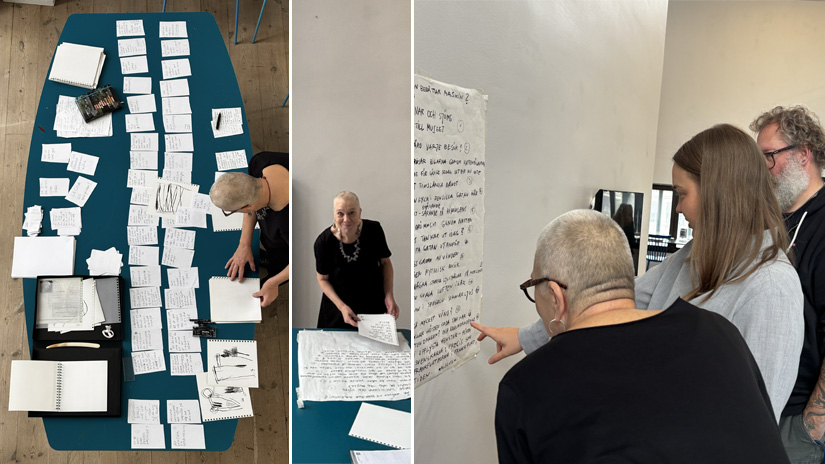
Then the rain forced us to move our walk indoors, and the shelter itself became the place where we gathered. Four other people joined us in exploring the structure and the ideas behind it. We talked to one another, tried things out and asked ourselves what it means to enter this rudimentary space, to sit inside it and to feel enclosed by its wooden surfaces. I had prepared a questionnaire to spark a conversation. But initially, the participants were already asking the questions themselves; they became bigger than the prepared sheet of paper on which they were written…
So, following this questioning by the participants and their physical exploration of the object, we turned to my questionnaire. When I asked what first came to mind when they heard the word ‘shelter’, the answers ranged from a roof to a feeling of safety. One person thought of confidence. Another thought of memories. A side note: I didn’t analyse the answers to the questions until after the event. But the participants had already asked this opening question whilst exploring the site. There was no single definition that we could all have agreed on.
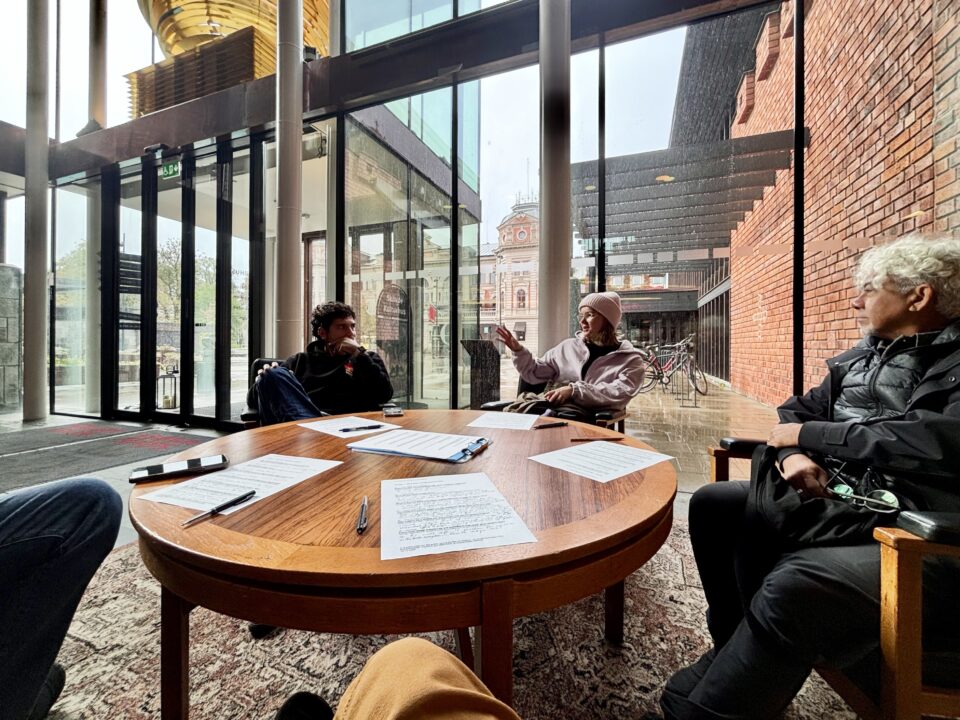
And this is precisely what gave me pause for thought: I had started from the premise of a structure – something I could design, build, move and alter. Yet the longer we talked to one another, the clearer it became that the meaning of a safe space does not lie primarily in its physical form. It lies in the experiences that people bring with them. For someone who has experienced war, safety can mean the difference between life and death. For another, it might be privacy, the chance to be alone, or simply the shelter of a log cabin from the rain. Yet another person feels safe in conversation, in the company of friends, or in a landscape they have known since childhood.
One person spoke of insecurity as something from which they needed protection. Another emphasised how important it is to be with people who recognise and respect others’ boundaries. And one of my own answers stuck in my mind in particular:
How does one design love?
I had phrased this question in response to the query: if I were to design a shelter to meet a fundamental human need, what would it offer? Perhaps my answer was an attempt to sidestep the question. But perhaps it was also the most honest answer I could give. We know how to enclose spaces, and how to design roofs, entrances and thresholds. We can calculate load-bearing capacities, determine heat loss and ascertain whether a structure can withstand the weather conditions. But how do you design the conditions under which people feel welcome? How do you create a place where someone can let their guard down, where being together does not mean giving up one’s privacy, and where protection does not become a restriction?
A shelter must offer a certain degree of security and enclosure. At the same time, it must allow us to leave it again. One of the participants summed up this very idea: the best shelter is not necessarily the safest if you do not have the freedom to leave it. For me, this touches on a fundamental architectural question. Protection and freedom are not opposites, but neither do they automatically go hand in hand. A space can offer protection to one person whilst excluding another. A place that feels familiar to me may feel alien and unsafe to someone else. The same walls, the same entrance, the same roof – and yet a different experience of being in the world.
The small wooden structure began to behave like a multi-purpose tool. Everyone seemed to envisage something different within it. It could be a place of solitude, a meeting point, a refuge, a temporary space, or simply a framework through which we could re-examine our relationship with our surroundings. Its openness was not a shortcoming that needed rectifying. It was precisely this openness that enabled us to project our own needs onto the structure.
This also led us to reflect on the building in which we found ourselves. The Kulturhus, too, had undergone a transformation: two originally separate buildings had been joined together in the 1990s. This created a sheltered entrance area following complaints about the wind. A practical intervention had altered the way people approached and entered the building. I realised once again that architecture is rarely a definitive solution. Buildings take on new uses, are confronted with changing expectations and must sometimes adapt to the life that unfolds within and around them.
This presents a tension that I recognise from my own work. As architects, we invest ideas, knowledge and care into the things we create. Yet a building does not belong solely to its designer. It belongs to the people who use it, inhabit it, alter it and imbue it with meanings that were never part of the original design. How can architecture remain open to such changes without losing its integrity? And how much of our attachment to a design is actually an attachment to our own intentions?
As we concluded our conversation, the rain gradually eased off. We left the sheltered space of the Kulturhus foyer with the mobile sculpture and exposed ourselves to the wind and drizzle on the forecourt. And we examined the spatial effect of the object in relation to the dimensions of the square and the striking buildings surrounding it. Playfully, we explored once more the sheltering effect of the sloping roof, alone and in pairs. And the group photo taken from the small tripod ended up as the cover photo for the latest volume! The planned walk through the town had turned into a journey into the meanings we associate with shelter. Physically, we had barely moved forward. And yet I felt as though I had travelled a long way.
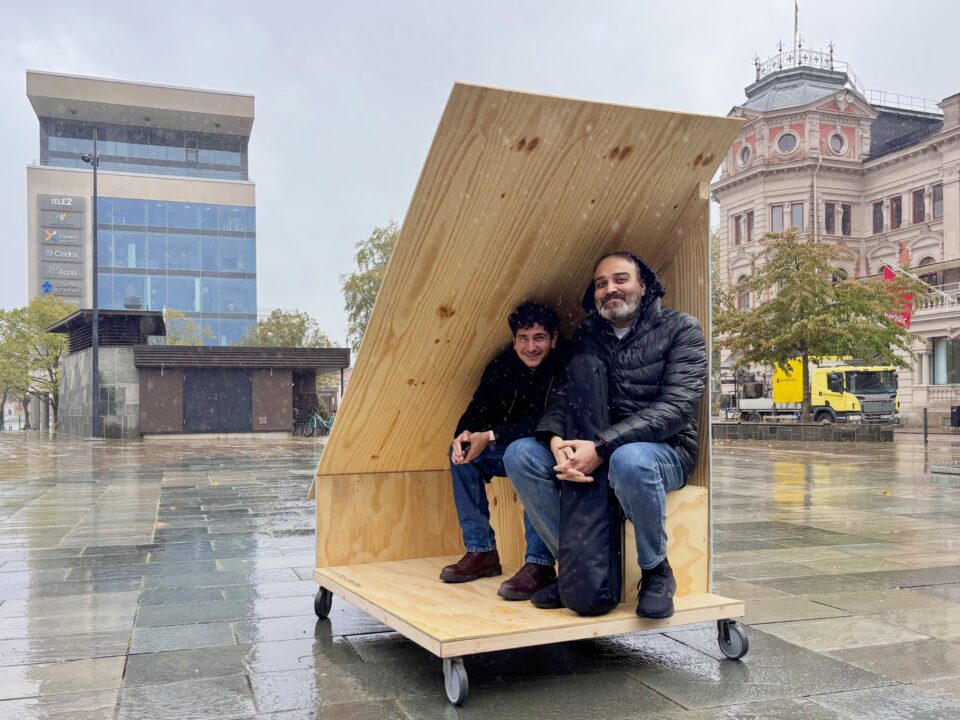
I came to Skövde after having worked for almost twenty-five years within the familiar routines of my architectural practice in Frankfurt. Here, as part of ‘Footnotes for … Skövde’, I am attempting to loosen and blur the boundaries between architecture, artistic practice and everyday life. Walking becomes a method of research. The city becomes a field of investigation. The body becomes an instrument of perception. And a structure becomes an opportunity to ask questions rather than provide answers.
Perhaps that is also one reason why I wanted to build the shelter myself. I had to step out of the familiar role of the architect who develops a project towards a defined outcome. I wanted to create something provisional, something that could be tested, questioned and reinterpreted by others. Something that would only become complete once people began to use it.
What remains for me is not the design of a specific safe space, but the realisation that there can be no universal answer to the question of what gives us a sense of security. Certainly, there are shared human needs. Yet we experience them through our individual stories, memories, relationships and life circumstances. Architecture can create conditions. It can offer shelter, openness, intimacy and the opportunity for encounter. But it cannot dictate how these conditions are experienced.
Perhaps, then, the task is not to design the perfect shelter. Perhaps it is about creating spaces in which different people can discover for themselves what shelter means to them – without assuming that their answers must be the same as ours, the architects’. And perhaps, as an architect, I must leave some things unfinished. Because the questions remain open.
Searching for Shelter. A small wooden structure, five perspectives and a rainy afternoon.
A footnote for … Skövde.
A question for architecture.
And a reminder that sometimes it is not the structure itself that offers us shelter, but the space we open up for one another within it.
Text: © Harald Etzemüller
Photocredits: Title, 1 © Vládmir Combre de Sena, others © Harald Etzemüller