Today, I took the regional train back from Stockholm to Skövde. My week-long visit to Stockholm has provided me with many new insights and ideas that will be invaluable for my ongoing work in Skövde.
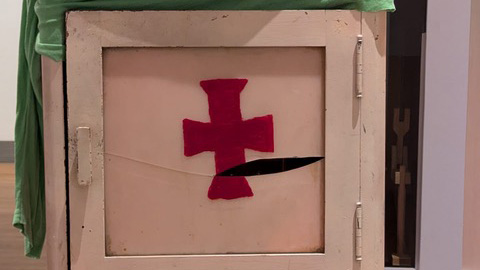
Among other things, I visited the small yet deeply moving ‚The Immeasurable‘ exhibition by Nils Petter Löfstedt at the Fotografiska Museum, which highlights the invisible work of care.
In a meritocratic society characterised by economic efficiency, the question arises as to what standards should be used to measure care work, given that trust, patience and human presence are the most important aspects of this job. (Lena Klingbach, 30 August 2026).
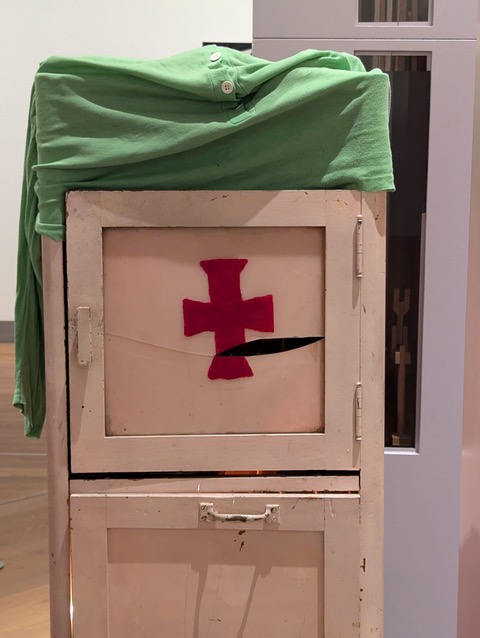
Installation view. Per Olof Ultvedt, Manhattan tjugo år senare, 1963-1983
Foto © Anette Kaplan
Interestingly, I met a fellow passenger named Angeliska (name changed) on the train. She used to work as a nurse before retiring. She is a very open, friendly and approachable woman, and I struck up a conversation with her effortlessly. We discussed at length the pressing questions I had brought with me to Skövde: questions about gender equality in Sweden, genuine equality within families, and care work. I am so glad to have met Angeliska, as she can tell me so much about these topics from her own experience.
‚In principle,‘ she tells me, ‚equality is taken very seriously in Sweden. Women are free to choose whatever career they wish to pursue, just like their male colleagues.‘ ‚Well,‘ she says with a mischievous smile, ‚in the end, it’s mostly men who end up in decision-making positions.‘
However, when it comes to bringing up their own children, fathers are involved and take on many of the day-to-day tasks that inevitably arise in a family with children. Angeliska tells me about her own family. As a nurse, she had to work shifts and often didn’t have weekends off. Her husband naturally took on all the childcare at the time, such as having breakfast with the children, getting them dressed and ready for nursery and school, and taking them to their respective settings. However, the situation took an unexpected turn whenever her husband had to go away on a business trip. Then the entire organisation – juggling ‚Grandma’s help‘, the childminder, and begging the nursery to look after the children a little longer or earlier as an exception – fell to her. She suddenly had full responsibility again and often didn’t know how she was supposed to juggle that with her irregular working hours.
Angeliska tells me that the situation is even worse in the professional care sector. Most people working in the care sector in Sweden have a migrant background. The work is generally underpaid and posts are usually understaffed, which leads to enormous time pressure and increases the workload. Remarkably, many Swedes look down on those who work in care, even though it is important and meaningful work that we will all come to rely on sooner or later.
It’s a demanding and responsible profession, Angeliska explains, and many of her colleagues give up early on because they can no longer cope with the strain. And yet, she tells me with a glowing smile, it has always been a wonderful job for her. She continues to volunteer as a carer at a social care centre for elderly people with disabilities. She is delighted to be able to offer these people warmth and dignity, and she values the social cohesion within this community.
Thank you, Angeliska, for being such a wonderful, caring person!
Thank you for the open and warm conversation!
Yours, Anette