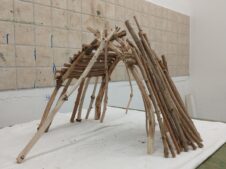
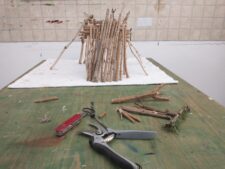
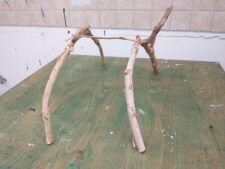
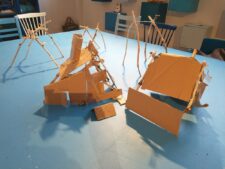
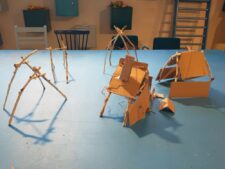
Whilst preparing for the residency in Skövde, whilst searching for historic houses in Sweden, I came across the architecture of the Sámi, the reindeer herders from Sapmi, in the north of Sweden, Norway and Finland. I am fascinated by how they use the materials they find to build extremely weather-resistant dwellings with as little energy as possible and using very simple tools. Trees bent by the wind, for example, form part of the structure. Here are some photos of a model of the basic structure of a ‘Goahti’ or ‘Kota’, taken in my studio in Weiterstadt. All I needed was a few spruce twigs from our ridge and some garden cuttings, as well as secateurs, a pocket knife and a hand drill. This is exactly the sort of model I wanted to build in my workshop together with students from the ‘Kulturarbetscentrum Rosa Huset’!
My interest in Indigenous cultures and ways of life began with the story of a Sámi girl that I read when I was about eight years old. It vividly described life within the community, the close relationship with the migrating reindeer herds, and how this came increasingly into conflict with the growing number of settled farmers. Even today, there are reindeer herders who, whilst living in modern houses, using snowmobiles and running their reindeer herding as a business, nevertheless strive to maintain their close relationship with the animals and with nature in the face of considerable opposition. The Sámi author Ann-Helén Laestadius recounts this in her book *The Glow of the Reindeer*, which I carried with me during my first few days in Stockholm and Skövde. I believe that, as a whole, we in Europe can learn a great deal from this approach, and perhaps this also holds the key to renewing our relationship with nature. I think we urgently need this in order to find solutions to the many environmental problems we face.
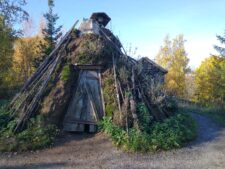
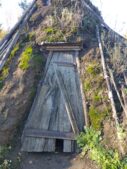
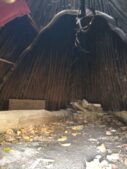
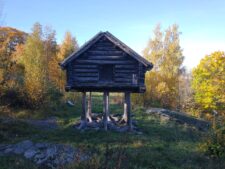

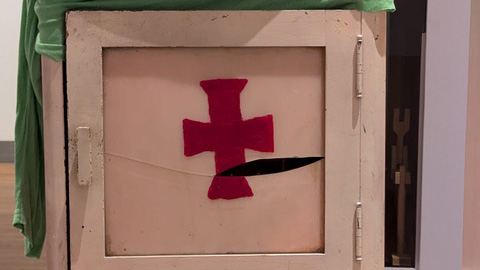
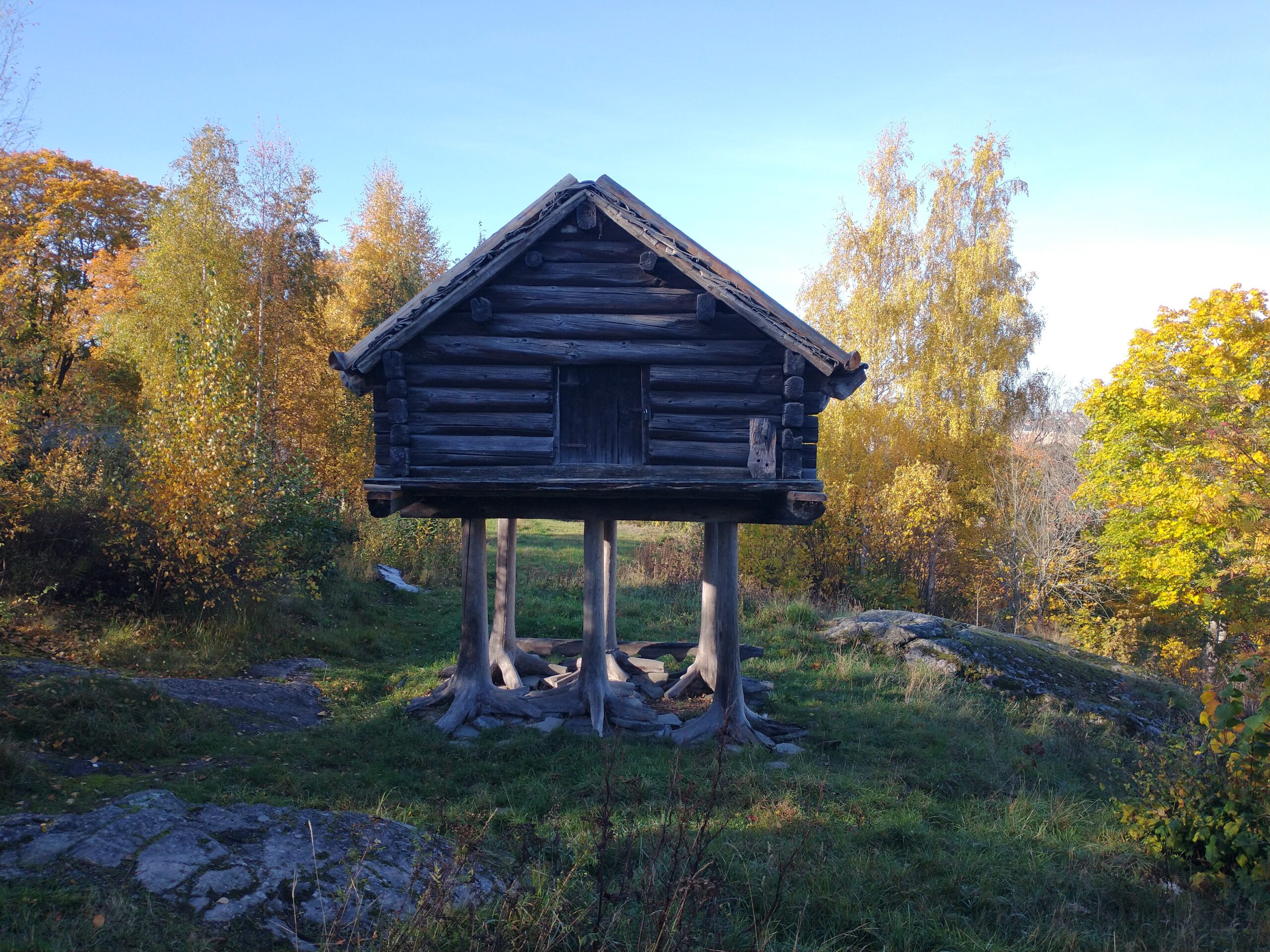
At Skansen Park in Stockholm, I was able to visit a peat-covered ‘Goahti’ and a traditional storehouse. I took a photograph of the interior through a hole in the door. The storehouse once again demonstrates how the natural environment is utilised. The roots of the trees, which are used as stilts, provide additional stability. There are even forest reindeer there. As their name suggests, they live in the forest and are slightly larger than the reindeer usually kept by the Sámi.
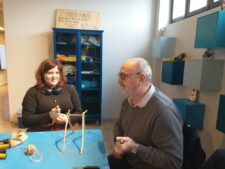
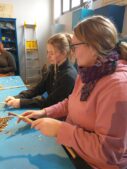
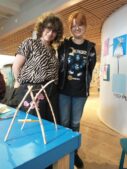
In my workshop with the students from the ‘Kulturarbetscentrum Rosa Huset’, I briefly introduced these topics, but then we got straight down to work. I was thrilled by the enthusiasm and creativity with which they set about their work, and by the beautiful results they produced!
In southern Sweden, where Skövde is situated, there are few traces of the Sámi people. However, when asked, some residents know members of this ethnic group, or have Sámi ancestors or relatives. In her song “Emptiness”, which she performed at the Kulturhuset Skövde as part of the Eurovision Song Contest preliminary round, the singer Gaeya incorporates elements of “joik”, the traditional Sámi form of singing. I liked this song immensely and, in my opinion, she won the preliminary round deservedly.
I was delighted that she was willing to take a selfie with me and I’m looking forward to her next performance in Frankfurt am Main.